
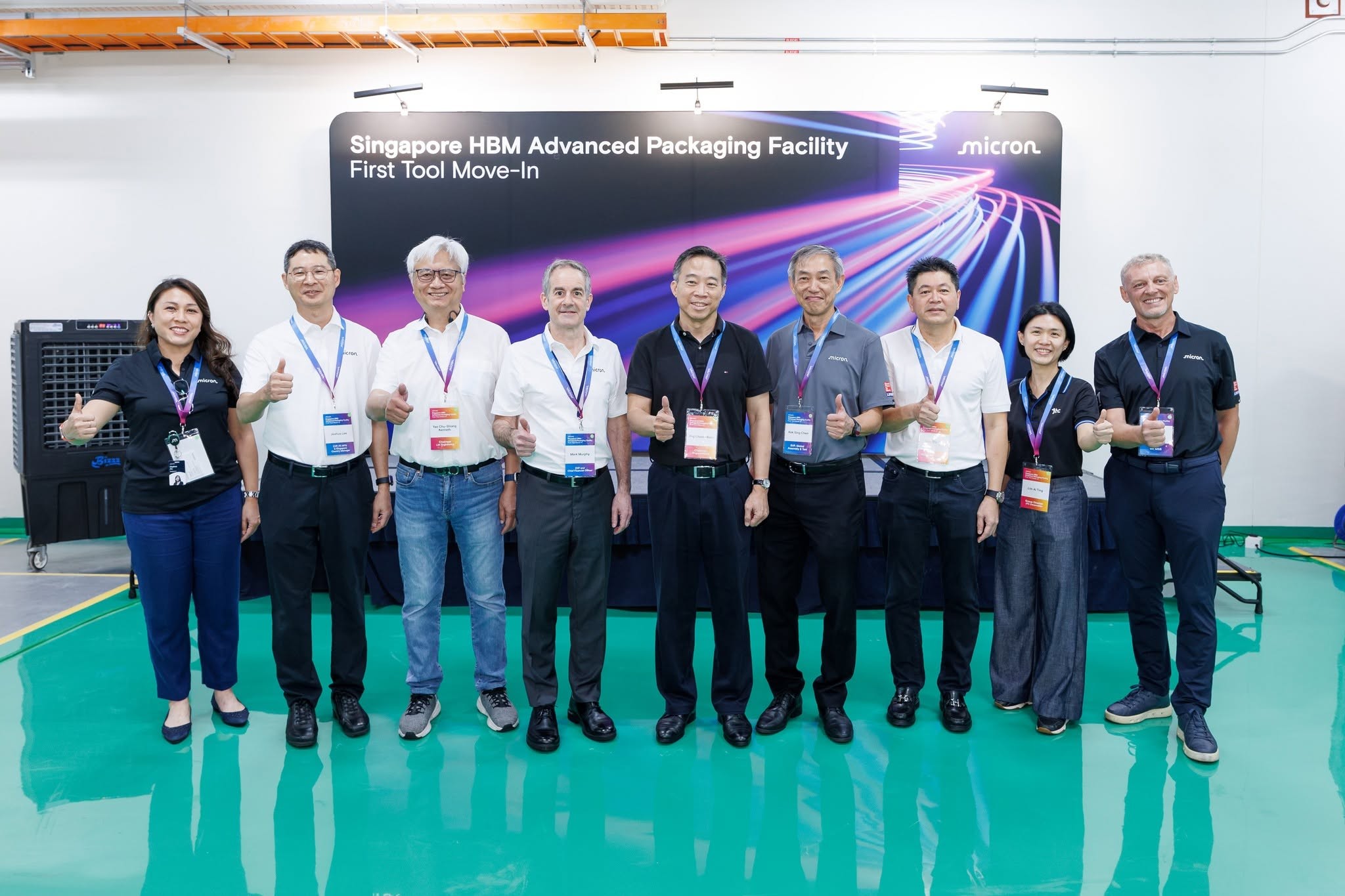
Micron Technology has committed 75% of the high bandwidth memory it expects to produce in 2027, a year for which most of that capacity has not been built. The company disclosed the figure as it moved the first production tool into its Singapore packaging plant on Nov 20.
The plant is scheduled to begin volume production in early 2027. Installing equipment is an early step in a long sequence. Process qualification, yield ramp and customer signoff all follow, and none of them moves quickly for memory that must be stacked, thinned and tested to tolerances measured in microns.
Selling three quarters of a year’s output this far ahead is not how the memory business usually works. Makers typically sign annual agreements with a quarter or two of visibility, and buyers hold back when prices look likely to fall. Micron’s disclosure suggests buyers are now contracting for capacity before the machines that will make it are wired up.
Executives said supply will be tighter in 2028 than in 2027. That inverts the normal sequence, in which new capacity arrives, loosens the market and pushes prices down. The company is telling investors that demand is compounding faster than fabs and packaging lines can be added.
Micron also said its largest customers are discussing 3D DRAM cooperation. That design stacks memory cells vertically instead of relying only on shrinking them, and it would extend the road map past the current generation of high bandwidth parts.
3D DRAM is a longer project. Research groups and memory makers have published work on stacking cells for several years, and the first commercial parts are not expected before the end of the decade. Customers discussing cooperation now are negotiating access to early samples, not ordering product.
The demand behind those conversations is concentrated. Nvidia this quarter lifted its memory purchasing commitments to $390 billion, making the chip designer the most direct force behind the shortage. A customer that size sets the tone for pricing across the industry, and rivals can respond only by adding capacity.
Capacity is the hard part. High bandwidth memory is less a wafer problem than a packaging problem. DRAM dies are stacked, joined with vertical interconnects and mounted beside a processor. Each step adds yield risk, and the tools that perform them are in short supply.
Singapore is not a new location for Micron. The company has assembled and tested memory there for years, and the island’s port, its engineering base and its distance from neither Taiwanese fabs nor Chinese customers made it an obvious site for the packaging step. Governments in the region have also been willing to share the cost of capacity that stays inside their borders.
That is why Micron is spending on packaging rather than only on wafer fabs. The company is building out manufacturing in Idaho, New York and Hiroshima, while the Singapore site handles the assembly step that turns DRAM into something an AI accelerator can use.
Pricing reflects that scarcity. High bandwidth memory has sold at a premium to conventional DRAM for three generations, and the premium widened this year as suppliers allocated output. Micron does not publish contract prices, but its gross margin guidance has moved with the mix, and analysts have modeled further gains on the assumption that the premium holds through 2027.
Rivals face the same arithmetic. SK Hynix has led the high bandwidth market and holds the largest share of orders from Nvidia, while Samsung has been working to qualify its own parts with the same customers. Both are adding lines, and both have told investors that demand exceeds what they can ship.
Analysts said the pre-sale figure is credible but narrow, because it covers volume rather than price. Contracts signed months before production can carry renegotiation clauses, volume bands and cancellation terms. Buyers who signed in a tight market may revisit those terms if the buildout slows.
There is a second risk buried in the disclosure. Memory has had three downturns in the past fifteen years, each preceded by confidence that demand had become structural rather than cyclical. The industry’s habit is to add capacity during a shortage and discover the surplus at the worst possible moment.
Micron’s own record shows the pattern. The company posted a record loss in 2023 after DRAM prices collapsed, then swung back to profit as AI demand arrived. Its share price has tracked the memory cycle far more closely than any product announcement.
For now the cycle points up. Server builders remain constrained by power and by packaging, and the largest cloud buyers have said they intend to keep spending. What investors will press on is how much of the 2028 tightness Micron forecasts is visible in signed contracts rather than in conversations.
The answer will arrive in the next two quarters of guidance. It will also show in whether the customers who reserved 2027 output accept the prices that come with it, or whether the reservations turn out to be options rather than commitments.



