The site is thirty acres in Hunt County, east of Dallas. The lease runs ten years. The rent is $1 billion. The tenant has not been named.
Giga Energy, a Houston data-center developer, disclosed the agreement on Tuesday. The counterparty is described only as a United States artificial-intelligence cloud provider. Under the lease, Giga will deliver 60 megawatts of capacity at a campus called Project Clay in the spring of 2027. The company said the site uses a closed-loop cooling design and is built so that it does not consume the distribution capacity that serves nearby homes and businesses.
Landlord disclosures rarely name their tenants, and the omission here is standard. What the numbers say is more useful than the name.
One billion dollars over ten years for 60 megawatts works out to roughly $1.67 million per megawatt per year, or about $139 per kilowatt per month. That is rent, not power, not construction and not the networking equipment inside the building. Rates in that range describe a market in which capacity is scarce enough that a tenant will sign for a decade to get it.
The absence of a name is also a signal about who signs such leases. The large cloud providers negotiate their own power contracts, buy their own transformers and increasingly build their own shells. A company renting a finished campus from a developer at a fixed rate is buying speed rather than cost, which is what a firm racing to add inference capacity does.
Giga’s own history explains why it is selling that speed. The company began in 2019 by putting shipping-container computers on oil and gas sites and running them on natural gas that would otherwise have been flared. That business taught it how to secure power in places where the grid had none, and how to build fast on land nobody wanted. Moving from that to purpose-built data centers is a change of customer rather than a change of skill.
Hunt County sits inside the Electric Reliability Council of Texas, the state’s main grid, and Texas has become the busiest market in the country for computing capacity. The consequence is a queue. Large loads now wait years for an interconnection study, and the state has responded by tightening the rules. Legislation passed in 2025 created a framework under which very large customers can be curtailed when the grid is short, in exchange for a faster path to connect.
That framework shapes design decisions. A campus built to be curtailable can accept an interruptible supply and pay less for it. A campus that intends to keep running through a grid emergency has to secure firm capacity, which in Texas usually means generation on site or a contract with a plant next door.
The claim that Project Clay will not draw on the distribution capacity serving residents points toward the first model. If a site connects at transmission voltage or supplies part of its own load, the local utility’s feeders and substations stay available for the houses and businesses already on them. That matters politically as much as technically: county commissioners in Texas have spent two years hearing from residents about data centers raising bills and draining aquifers.
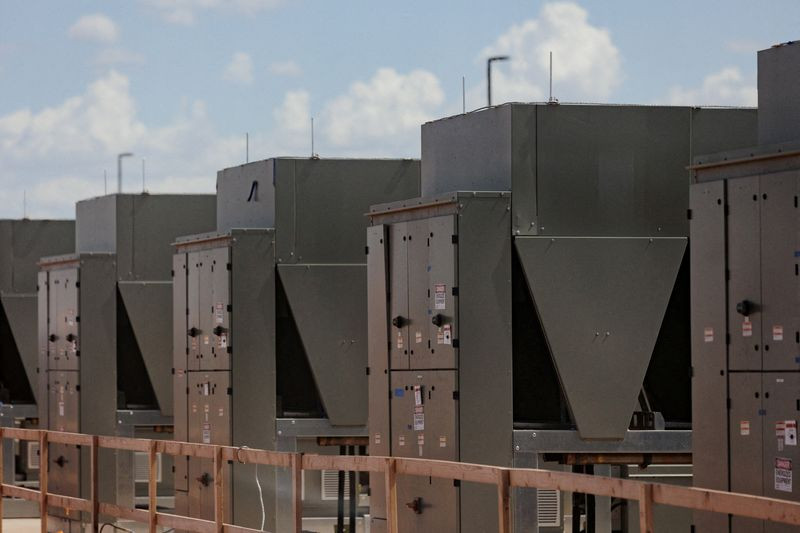
Cooling is the other local flashpoint. Closed-loop systems circulate a fixed volume of fluid through a heat exchanger, which cuts the water a campus consumes to the amount lost to evaporation and maintenance. The design costs more to build and less to permit. In a county where the water utility has to certify supply before construction, the second figure is the one that decides the schedule.
The schedule is where the risk sits. Spring 2027 is eighteen months away, and the equipment a data center needs has lead times measured in years. Gas turbines are sold out through the end of the decade at the major manufacturers. Large transformers take two to three years. Switchgear, generators and the specialized cooling units all compete with every other project in the same queue, and a developer without a purchase order placed years ago is a developer waiting.
Giga has not said how much of the equipment is already ordered, and it has not said what happens if delivery slips. A lease of this size usually carries penalties for late delivery and provisions that let the tenant walk if a threshold passes. Those terms are not public.
What is public is the direction of the market. A single 60-megawatt building on thirty acres, rented for a decade in advance, describes a customer that expects demand for inference to still be growing in 2037. Half an acre per megawatt is a dense build by the standards of five years ago and an ordinary one now.
The company’s next disclosure will matter more than this one. Giga has other sites in development, and the terms it obtains for them, at whatever prices, will show whether this lease was an outlier or the new floor. For now the number on the table is a billion dollars for land, concrete, cooling and a connection to a grid that is being asked to absorb more load than it was built for.