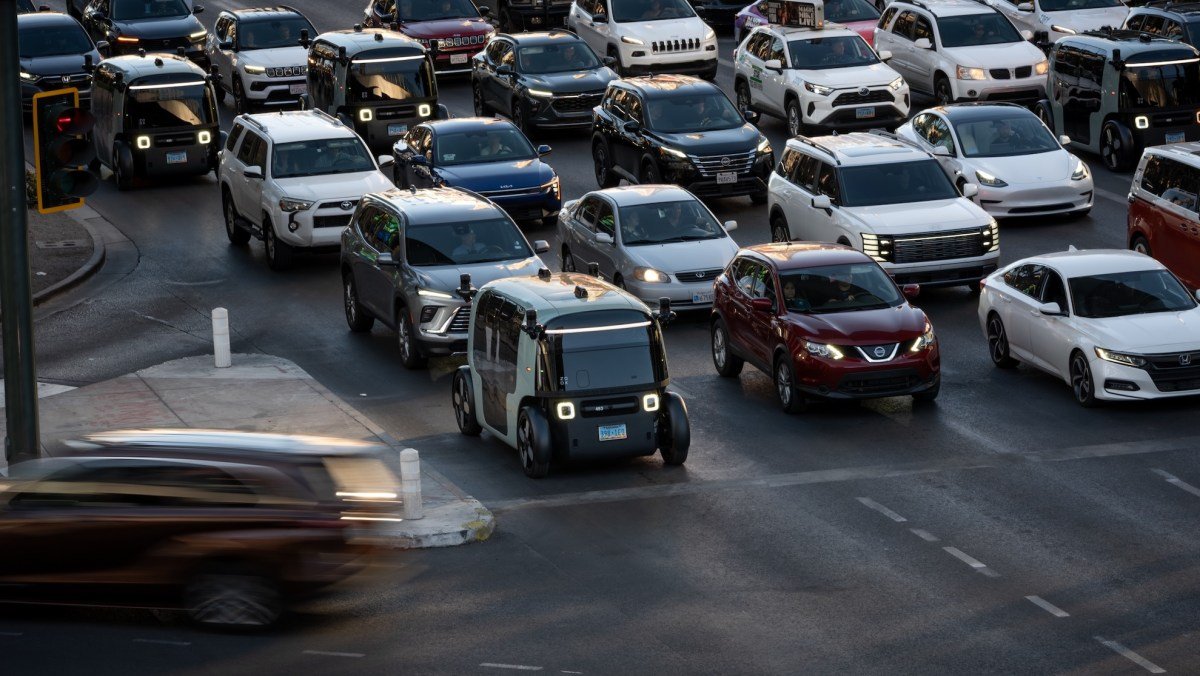
For the past year, a single number has defined Zoox’s presence in Nevada: one hundred. The permit the Amazon-owned company held limited its fleet to 100 vehicles, a ceiling that shaped how fast it could grow. That ceiling expires on September 25, and the renewed version of the permit carries no cap at all.
Zoox now has about 100 custom-built vehicles, machines with no steering wheel and no pedals, spread across four American cities, with the main operations in Las Vegas and San Francisco. The company charges for rides only in Las Vegas, and it will need a separate permit before it can do the same in California. The Nevada change removes the binding constraint in the one market where the company actually collects fares.
The custom vehicle is the point of the whole enterprise. Zoox builds its cars from the ground up for autonomy, without the conventional controls, on the theory that a vehicle designed for a robot does not need to be adapted to a driver. That design choice sets Zoox apart from competitors that retrofit existing cars, but it also means every new vehicle must pass its own regulatory review.
The federal layer moved in August, when Zoox received a temporary exemption from the National Highway Traffic Safety Administration. That exemption lets the company deploy up to 2,500 vehicles a year for two years, a far larger number than the Nevada cap would have allowed. The state permit and the federal exemption have now been aligned, and the fleet has room to grow.
The growth is happening in a city that is suddenly crowded. Waymo opened its service in Las Vegas at the beginning of the month, and Tesla and Uber have also received permits for driverless passenger operations. Three permits, taken together, allow up to 7,000 vehicles to be deployed over the next twelve months, a number that would have been unthinkable in Las Vegas a year ago.
That concentration is changing the competitive logic of the market. Las Vegas has become one of the few places where several robotaxi operators are running at once, which makes it a live experiment in whether the economics hold when the field is not a monopoly. Prices, wait times and vehicle availability will answer the question the business plans have so far only asserted.
For Zoox, the race is against the field as much as it is against the regulator. The company has a differentiated product, the purpose-built vehicle, but differentiation only matters if the company can scale it before rivals with conventional cars saturate the market. The lifting of the cap gives Zoox the room it asked for; now it has to fill it.
The California piece is the unresolved half of the story. Zoox operates in San Francisco but does not charge there, and the permit it needs to turn those operations into a paid service is still pending. The company’s growth, in other words, is concentrated in Nevada for now, which makes the Las Vegas permit the more important document.
The safety question follows every one of these expansions. A vehicle with no steering wheel cannot be taken over by a human, which means the system has to be right the first time, every time. The regulators who lifted the cap have decided the record so far justifies the room, and the market will now watch whether the record holds as the fleet grows.
The Amazon connection sits behind all of it. Zoox has the backing of a parent with the patience and the capital to fund a long autonomy race, and the purpose-built vehicle is a bet that the eventual winner will need a car designed for the task rather than adapted to it. Whether that bet pays off depends on the next twelve months, when the cap is gone and the competition is in the same streets.
What happens after September 25 will be a test of more than Zoox. Las Vegas is about to become the most crowded robotaxi market in the country, and the results there will shape the expectations for every city that follows. The cap is gone; the experiment is beginning.
The change in the permit is a small regulatory event with a large competitive meaning. A cap of one hundred vehicles is a ceiling on revenue, and a ceiling on revenue is a ceiling on how much a company can learn about running a real service. Removing the cap does not by itself add a single car to the street, but it removes the reason the company could not add them. In a market as crowded as Las Vegas is becoming, the difference between a capped fleet and an uncapped one is the difference between watching the race and running it.