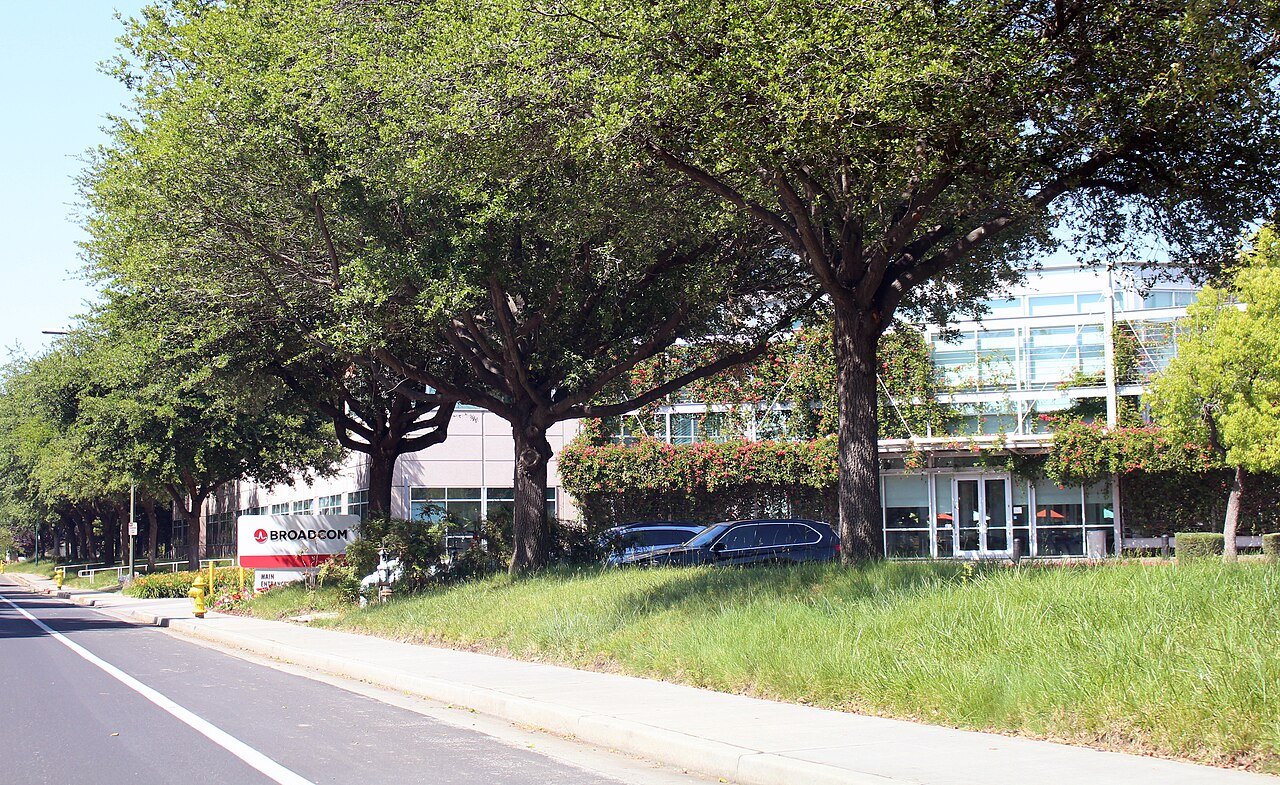
When Broadcom’s chief executive Hock Tan took questions on an earnings call in December, he gave investors a name they had spent three months trying to guess. The mystery customer behind a $10 billion order for custom artificial-intelligence chips was Anthropic, the company that makes the Claude chatbot.
The reveal has since hardened into something larger than a single contract. On Monday, analysts began arguing that Anthropic could become Broadcom’s largest custom-chip customer outright, and Broadcom shares rose. JPMorgan told clients to buy the stock “aggressively” at current levels. Morningstar, the research house, published an estimate suggesting the company’s AI-related revenue could reach $230 billion and said a 27 percent drawdown in the shares had buried that number from view.
The case rests on how Broadcom earns money in AI. Unlike Nvidia, which sells finished graphics processors, Broadcom builds application-specific integrated circuits, or ASICs, shaped to a single customer’s specifications. It is the silicon partner that turns Google’s tensor processing unit design into a manufacturable chip, supplying the high-speed networking, power management, and packaging that surround it. TSMC handles fabrication.
Tan said in December that Anthropic had placed a $10 billion order for the latest TPU “Ironwood” racks and added another $11 billion order in the company’s most recent quarter. Anthropic has since committed, through Broadcom, to access roughly 3.5 gigawatts of next-generation TPU capacity starting in 2027, part of a $50 billion pledge to expand American AI infrastructure.
The relationship has grown fast enough that analysts have begun attaching numbers to it. Mizuho’s Vijay Rakesh estimated Broadcom would record $21 billion of AI revenue from Anthropic in 2026 and $42 billion in 2027, figures published after the company’s March earnings call.
For Anthropic, the appeal is price and fit. Its workloads run across Google TPUs, Amazon’s custom Trainium chips, and Nvidia GPUs, and the company says it routes each job to the hardware best suited to it. Custom chips cost less per unit of computing than general-purpose GPUs on certain tasks, which matters more as power, not chip supply, becomes the real bottleneck for AI data centers.
The shift toward custom silicon is no longer confined to a handful of hyperscalers. Google has built TPUs for a decade, and last month the company said it had trained its newest Gemini model entirely on them. Amazon fields its Trainium and Inferentia lines, Microsoft its Maia accelerator, Meta its MTIA. Broadcom sits under a large share of this build-out as the design and networking partner, analysts said.
For Broadcom, the appeal is diversification. Its custom-chip division, which the company calls XPUs, already counts Google and Meta among its customers, and Anthropic is its fourth. A fifth customer placed a $1 billion order in the fourth quarter, though Broadcom has not named it. Analysts said the growing roster reduces the company’s dependence on any single buyer.
The stock’s 27 percent pullback, in Morningstar’s reading, reflects fear that AI spending will cool. Morningstar’s $230 billion figure is a ceiling rather than a forecast: it measures what Broadcom’s AI business could be worth if the current build-out continues and the company keeps winning a share of it. JPMorgan’s “aggressively buy” call amounts to a bet that the pullback overstates that risk.
Broadcom also competes with Nvidia in a second market: the networking chips that connect thousands of accelerators inside a data center. The two companies are chasing the same cloud providers and model developers, and every AI campus needs both the processors and the switches and optics that move data between racks. Analysts said Broadcom’s strength in that layer gives it a claim on AI spending that does not depend on winning the processor war outright.
Anthropic’s rise as a customer carries its own risk. The startup, founded in 2021 by former OpenAI researchers, spends heavily ahead of revenue, and its orders assume a growth path that has yet to be fully proved. If its funding slowed, so would its chip purchases. For now the direction of travel runs the other way: each quarter brings a larger commitment, and each commitment moves Broadcom’s custom-chip business closer to the center of the AI trade.
Hock Tan built Broadcom through a string of acquisitions, most recently the $69 billion purchase of the software maker VMware, which closed in 2023. The pattern was to buy mature businesses with durable cash flow and run them lean. The custom-chip and networking units are the newer growth engine, and the Anthropic orders are the clearest sign yet that Wall Street now values the company for that engine rather than for its older franchises.
The question for investors is whether the multiple the market assigns to that business will follow. For much of the past year Nvidia captured the premium that comes with owning the scarce resource in AI. Broadcom’s argument, increasingly, is that the scarcity has moved downstream, to the custom silicon, networking, and power that the model companies must secure before a single model can be trained.