The B round at Higgsfield was already closed. On Friday it got bigger, with Nvidia and TCV joining as new investors in an extension whose size none of the companies disclosed.
Higgsfield makes AI tools for generating and editing video and images. In August the company raised at a valuation of $5.4 billion, when its annualized revenue stood at $700 million. That figure has since passed $1 billion, according to a person familiar with the business.
The arrival of TCV is a signal in itself. The growth investor has backed Netflix, Spotify and Facebook, and it tends to enter when a company has revenue it can underwrite rather than a demo it admires. Nvidia’s participation is a different kind of signal: the chip designer rarely writes a check without a view on where compute demand is heading.
Video generation is where that demand is going. A single generated clip consumes far more compute than a text answer, and the companies competing in the category, among them OpenAI with Sora, Google with Veo, Runway, Luma and Kuaishou’s Kling, are all constrained by the same scarce resource. A startup with $1 billion in annualized revenue and a channel into consumer and marketing video is a customer Nvidia would like to keep close.
Higgsfield’s niche is narrower than the ambitions of the big labs. Its tools are built around camera control and preset motion, aimed at the short-form video market where a creator needs a particular shot rather than an open-ended prompt. That focus has produced revenue faster than a general-purpose model strategy would have.
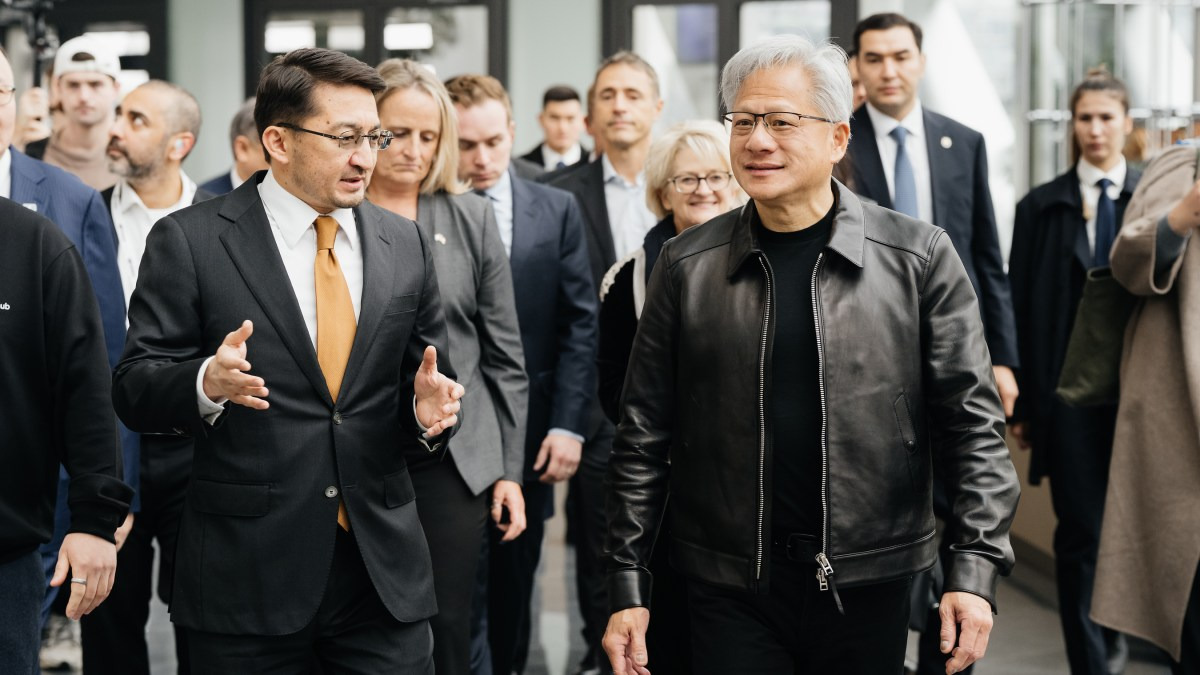
The same Friday, Bloomberg reported that Jensen Huang had traveled to Kazakhstan, his first visit to the country. Nvidia did not disclose what was signed, and the timing, beside an investment in video software, suggests a company working several geographies at once.
Kazakhstan is an unlikely stop for a chip executive and a logical one. The country is the world’s largest uranium producer, holds substantial oil and mineral reserves, and sits on surplus electricity in a region where power is the binding constraint on data-center construction. Its government has spent years courting technology investment and promoting the capital, Astana, as a financial and digital hub for Central Asia.
The country’s position is also delicate. It shares a long border with Russia and a shorter one with China, and Washington has pressed Central Asian governments for years over the transshipment of restricted technology, including advanced chips, through intermediaries in the region.
For Nvidia, sovereign AI has become a sales category in its own right. Huang has spent two years telling governments that they need domestic compute to keep their data and their models inside their borders, and that argument has produced deals from Japan to India to the Gulf. Central Asia is the next version of the same pitch, with a smaller check attached.
The video investment fits that logic from the demand side. Every model that generates a minute of footage needs a data center, and every data center needs accelerators. Nvidia’s venture arm has made a series of small strategic bets on model developers and applications over the past two years, generally taking minority positions and rarely leading rounds. The financial return is not the point.
The strategic risk is that Nvidia is now invested across competing video companies while supplying all of them. That is a familiar position for a company with stakes in model labs that compete with each other. Antitrust regulators in the U.S. and Europe have examined the pattern without acting on it.
Analysts said the more relevant question is margins. Video inference is expensive, and the startups that survive will be the ones that convince customers to pay per generated asset rather than per seat. Higgsfield’s revenue growth suggests it has found customers willing to do that, at least in the creator economy and in advertising production.
Advertising is where the money is closest. Agencies have been testing generated video for product shots and social cutdowns, and the cost advantage over a shoot is wide enough that procurement departments have started to ask for it. A tool that gives a creative director control over the camera is easier to sell into that workflow than a model that produces something surprising.
The August valuation of $5.4 billion against $700 million in annualized revenue was already rich by software standards. Crossing $1 billion within two months gives the company a defensible story for the extension and gives existing investors a mark to protect.
Nvidia and TCV declined to comment on the size of their commitments. Higgsfield did not say how it will spend the money, though compute contracts and sales hiring are the obvious candidates for a company in its position.
What the two Friday events have in common is a map. Nvidia is placing bets on where video demand will be generated and on where the power to serve it will come from. Kazakhstan supplies the second part. Higgsfield supplies evidence for the first.
The bet is not riskless. Creative tools have short product cycles, and the large labs keep adding video features to products that customers already pay for. A standalone company has to justify a subscription on quality alone, which is a harder sale when a competitor bundles the same capability into a suite.
That is the part of the story Wall Street will watch. Nvidia’s investment protects a demand channel. Higgsfield’s investors are buying a revenue curve. Whether the curve keeps its slope depends on whether agencies and creators keep paying for control over a shot, or settle for whatever the bundled models give them.