
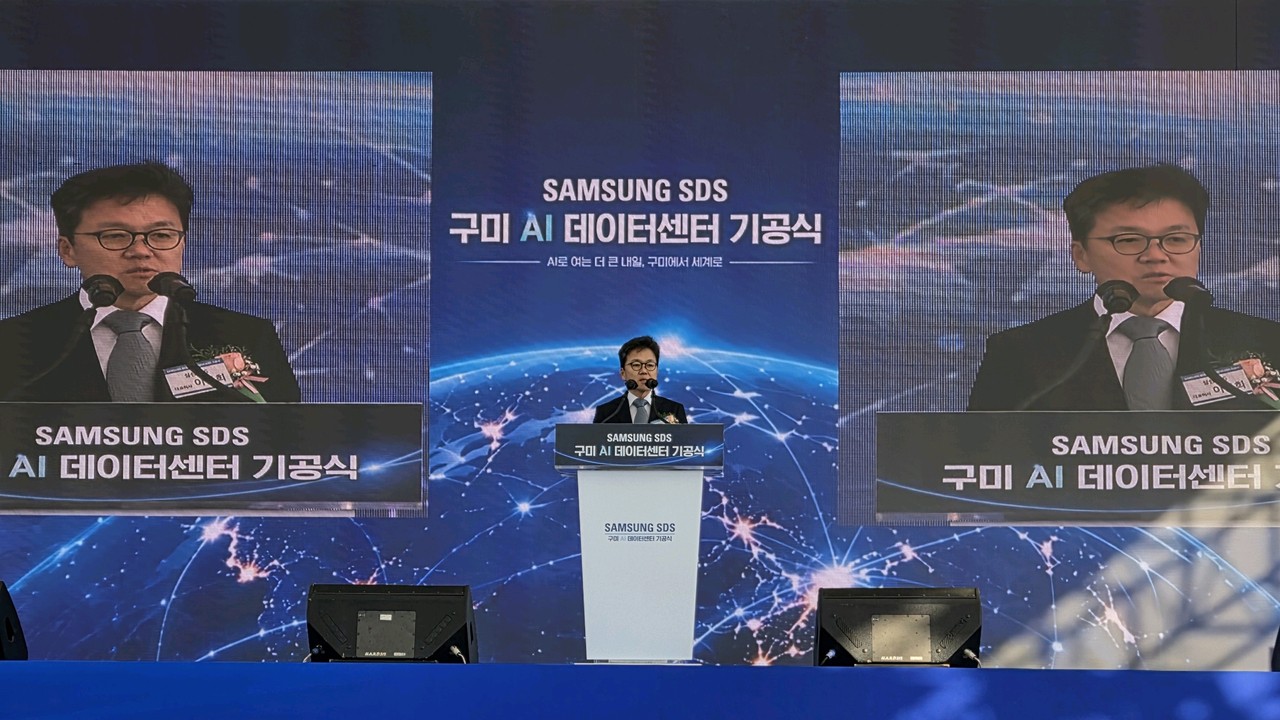
The road into Gumi’s industrial belt passes a row of component suppliers, a tire shop and a lot where new switchgear sits stacked on pallets. Behind a hoarding at the eastern edge of the city, Samsung SDS has started work on a data center it intends to scale to 120 megawatts, a load that puts electricity supply at the top of any construction schedule.
The site is the visible part of a strategy the Financial Times described on Nov 15. Samsung Electronics wants a second growth line beside memory chips, one that bundles data centers, engineering and construction, and power management into a package aimed at the artificial-intelligence supply chain.
The method is borrowed from the business Samsung already knows. Its chip arm was built by pushing separate subsidiaries to the front of their own fields, each with its own customers, its own engineering culture and its own profit-and-loss account. The group now wants the same arrangement in infrastructure, with affiliates bidding for work that hyperscale cloud operators are placing in Korea.
Gumi makes that pitch easier to sell. The city is where Samsung’s semiconductor business took root, and the surrounding province has spent decades assembling the suppliers, the housing and the permitting habits a large industrial project needs. A data center there draws on a labor pool that already knows how to run a clean room and a substation.
Work has also started at Asan, on the west coast, where Samsung is building a packaging plant for high-bandwidth memory, the stacked DRAM that sits beside AI accelerators. The two projects sit at opposite ends of the same argument. Memory packaging is a manufacturing problem the company has solved before and must now solve at volume; data centers are a service business with thinner margins, longer payback and a customer base small enough that every contract matters.
According to the Financial Times, the plan is to replicate the semiconductor playbook rather than invent a new one. That distinction carries weight. Industrial groups that move into construction usually buy their way in, absorbing a contractor and its liabilities; Samsung already owns the pieces, which shortens the learning curve and lengthens the internal politics.
Power decides whether the Gumi campus ever reaches its nameplate figure. A 120-megawatt facility needs firm capacity rather than intermittent supply, and grid connections of that size typically take years to arrange. Samsung’s advantage in that queue is patience. It can hold land and wait for a connection in a way that a financial sponsor answering to quarterly returns cannot.
Customers are the harder question. Hyperscale operators building in Korea can choose between global contractors with data center portfolios and local industrial groups with grid relationships and government contacts. Samsung is betting that the second qualification matters more than the first, and that latency-sensitive inference work will keep capacity close to the users it serves.
The financial case rests on what a second leg is for. Memory revenue swings with the DRAM cycle, and a construction and facilities business grows on contract awards, which are lumpier but less correlated with chip prices. Investors who have spent years valuing Samsung as a cyclical memory maker would get a slice of revenue that does not move with the spot price of a commodity.
There is a less flattering reading. Conglomerates that sell to themselves can produce growth that is real on a subsidiary’s income statement and circular at the group level. Samsung’s affiliates have traded with one another for decades, and the new line will be judged by how much of its order book comes from outside customers rather than from sister companies.
Samsung has not disclosed the order book it expects for the infrastructure business, nor the capital it intends to commit beyond the projects already under way. That silence is normal at this stage and also convenient. A strategy announced before a single megawatt is energized cannot fail yet.
What is measurable is the schedule. The first phases at Gumi, the packaging lines at Asan and the customer qualifications that follow will surface in subsidiary earnings before they surface in group revenue. Analysts who cover the affiliates will watch capital expenditure first and revenue second, because the spending is committed and the demand is not.
Competition will not wait for the qualifications. Korean engineering firms, global data center specialists and the construction arms of other conglomerates are chasing the same hyperscale contracts, and each has a claim: the specialists have reference sites, the local firms have land and relationships.
Samsung’s counter-argument is integration. It can supply memory, build the shell, wire the power and hand over a working hall, which removes a coordination problem that cloud operators currently solve with a general contractor and a lot of meetings. Whether that bundle is worth a premium or merely a discount is the question the first contracts will answer.
For now the eastern edge of Gumi is a fence, a road and a stack of equipment waiting for a crane. The announcement has been made. The part that matters will be the energization date, and nobody has published one.



