SEOUL—Two earnings calls, 24 hours apart, and a number that would have read as a typo a year ago. SK hynix reports on Wednesday and Samsung Electronics on Thursday, and together the two companies are expected to post about 184.4 trillion won, or $139 billion, in quarterly operating profit.
For context, the two earned 90.8 trillion won in all of 2025. They will now exceed that in three months, at a rate of roughly two billion dollars a day.
Samsung set the floor on Oct. 8 with preliminary figures: revenue of 195 trillion won and operating profit of 107.4 trillion won. On those numbers it becomes the first Korean company to clear 100 trillion won of quarterly operating profit. Analysts surveyed by FnGuide expect SK hynix to report 98.23 trillion won of revenue and 76.96 trillion won of operating profit, both records for the company.
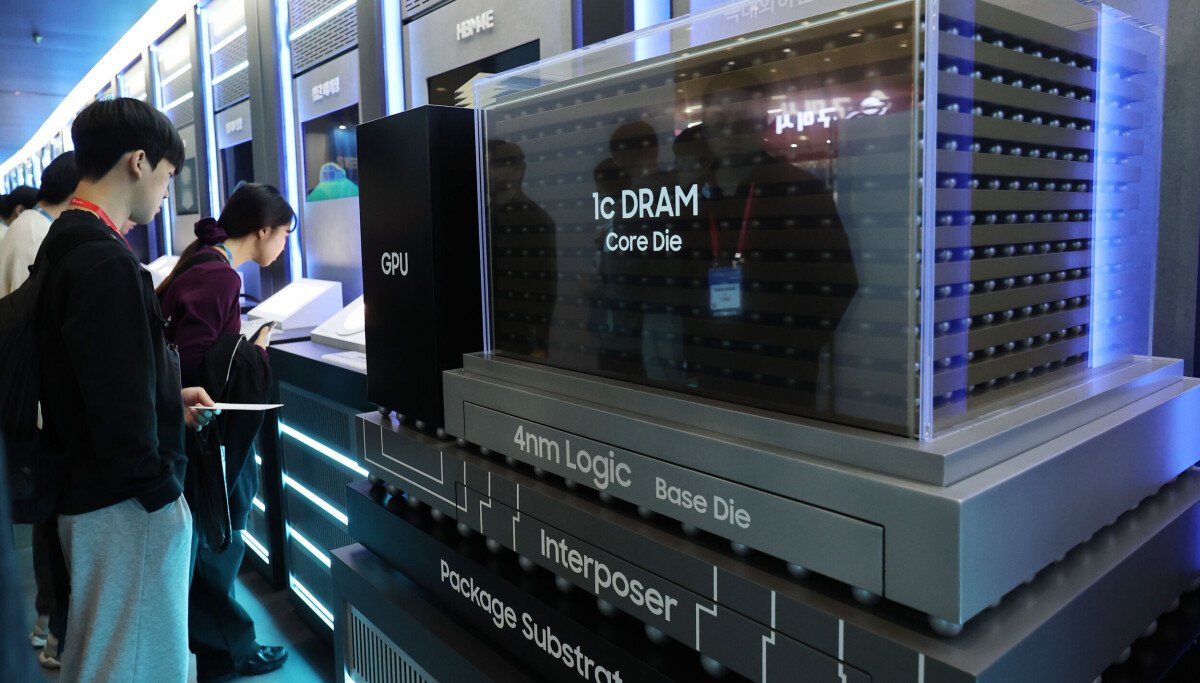
The driver is memory, and specifically the kind of memory that sits next to an AI accelerator. High-bandwidth memory is made by stacking DRAM dies and wiring them through vertical channels so that a GPU can pull data fast enough to stay busy. Nvidia’s next-generation Vera Rubin platform is moving toward HBM4, the sixth generation, and both Korean suppliers are racing to qualify and ship it in volume.
Conventional DRAM has done as much for the numbers. TrendForce estimated that contract prices for general-purpose DRAM rose 13% to 18% in the third quarter from the second, and expects another 10% to 15% in the fourth. Prices rose because capacity moved. Every wafer shifted to server memory for AI is a wafer not making the DDR5 that goes into laptops and phones, and the buyers of those parts have been paying up.
That combination, volume plus price, is why the profit line looks unlike anything in the industry’s history. It is also why investors have stopped rewarding it. Shares in both companies have fallen about 30% from their highs even as estimates climbed, a divergence that has become the defining feature of the memory trade this year.
The market’s reasoning is straightforward. Memory is cyclical, and a cycle that produces this much profit invites supply. Samsung is building its Pyeongtaek P5 lines, SK hynix is spending on the Yongin cluster and a packaging plant in Indiana, and China’s CXMT is expanding capacity with state support. Nobody knows exactly when the next glut arrives, only that the industry has produced one after every previous peak, including 2019 and 2023.
Samsung’s own record argues for caution. In 2023 it reported operating profit of 6.57 trillion won for the year, the weakest in more than a decade, and SK hynix lost 7.73 trillion won. Both were profitable again within two years. The swing from a loss of that size to a quarterly profit above 100 trillion won in three years has no precedent in manufacturing.
Attention this week will fall as much on what the companies say about returning cash as on the results themselves. Samsung’s board approved a shareholder return plan of 90 trillion to 110 trillion won for this year under a policy of paying out half of free cash flow generated from 2024 to 2026. Analysts expect dividends of roughly 30 trillion won. A quirk complicates buybacks: Samsung Life Insurance and Samsung Fire & Marine together hold a stake near the 10% ceiling that financial institutions may own in a non-financial company.
SK hynix has promised at least half of cumulative free cash flow from 2025 to 2027 and has said it would consider special dividends and further buybacks and cancellations. Korean media have reported a possible special dividend of 16 trillion won; the company says no decision has been made. Its funding options narrowed on Friday when Solidigm, the U.S. subsidiary it controls indirectly, halted a review of an initial public offering and pre-IPO fundraising.
Costs are the other half of the story. Samsung’s foundry business, which makes chips for other companies, is estimated by securities firms to have lost about 1 trillion won in the quarter, and its Taylor, Texas plant is consuming capital ahead of volume production. SK hynix must fund fabrication lines at a time when equipment prices are rising and long-term supply contracts for power and water are harder to secure.
“The earnings could continue to improve as AI investment expands and memory prices rise, but as the recent share price correction shows, market expectations have also risen considerably,” said Shin Jung-ho, head of research at LS Securities. What will matter, he said, is how much return the companies earn on that capital and how much cash they generate, rather than revenue growth alone.
There is a strategic question underneath the quarter. For two decades Korean memory makers competed on cost and lost money in every downturn. This cycle they hold something closer to pricing power, because HBM requires custom engineering with the customer and yields are hard to master. Whether they can keep that power depends on how fast Samsung closes the gap with SK hynix in HBM4, and on whether Nvidia and the hyperscalers decide that a third supplier is worth cultivating.
For the Korean economy, the quarter is a windfall. Corporate tax receipts will rise, the current account will swell and the won, which has been weak against the dollar, has found support. For the government, the two companies now generate profit comparable to the entire annual budget of several mid-sized economies, which makes their investment plans a matter of national policy as much as corporate strategy.
The risk that nobody can price is timing. Memory earnings peak when customers are most confident, and orders placed at the top of a cycle arrive as capacity when the cycle has turned. The companies will be asked on Wednesday and Thursday how much of this profit they intend to spend on new capacity, and the honest answer, which no chief financial officer gives, is more than is comfortable.