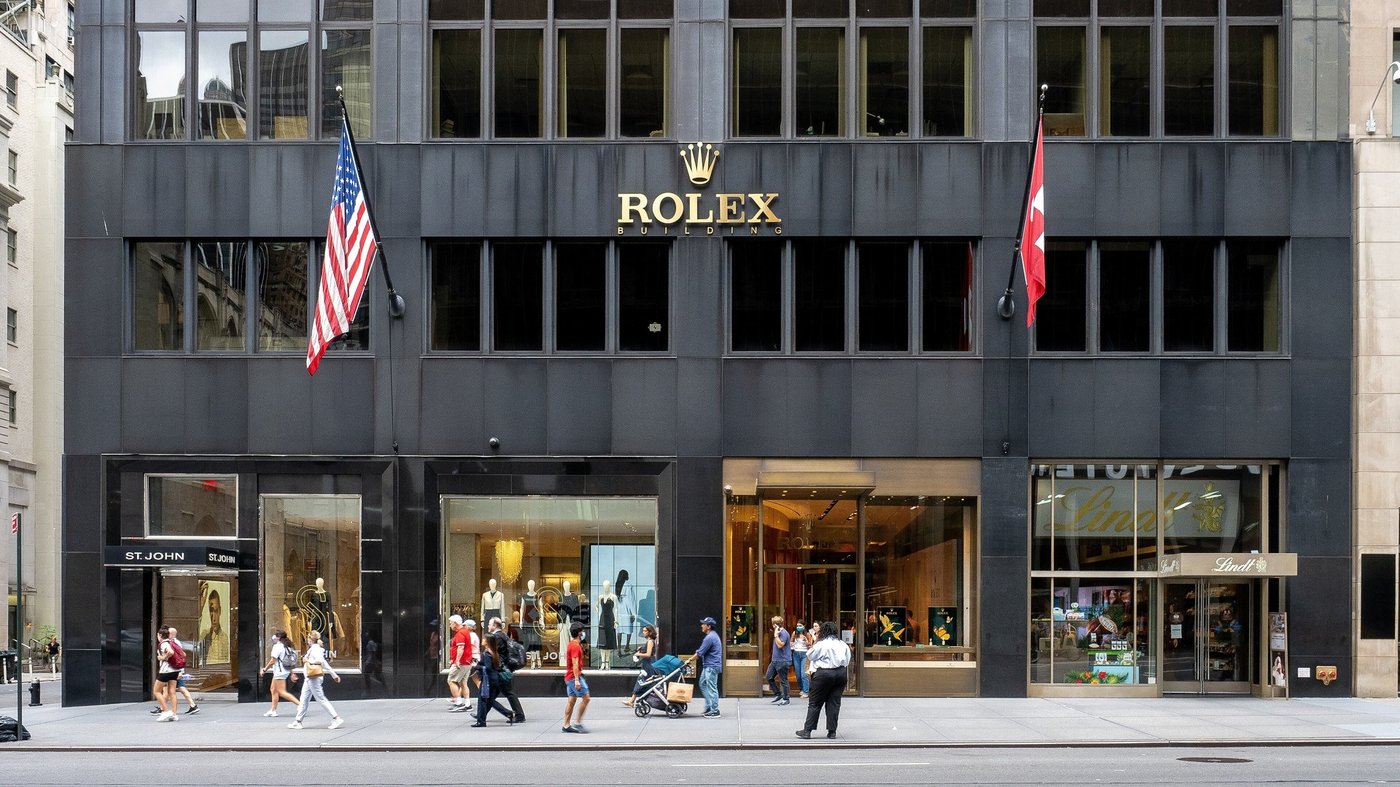
Before there was a trademark application, there was a plate. Rolex has had a pastry chef make desserts carrying the brand’s crown for its most valued clients, an exercise in hospitality that stops well short of a shop. The plate was a gift. A filing with the US Patent and Trademark Office suggests the company has started thinking about what happens when the plate is on a table somebody can book.
The application, filed by Rolex’s American arm, covers ROLEX CAFÉ as a mark for cafe services. It specifies no typeface and no colour scheme, which is what a placeholder looks like: a claim on a name before anyone has decided what the name will look like on a cup.
A Filing Is Not a Lease
Trademark registrations are cheap relative to almost anything else a company of Rolex’s size does, and they are routinely filed years ahead of use. The filing on its own proves intent to protect a phrase, not the existence of a coffee shop.
The reason to take this one seriously is the building. A new flagship on Fifth Avenue is due to open next year, and reporting on the plan has said the store may be run by Bucherer, the retail partner named in that reporting. A flagship that size needs a reason for people to stay in it, and a cafe is the cheapest such reason ever invented.
That combination is what makes the paperwork legible. A mark, a building, and a service category that turns a showroom into a place with opening hours longer than a sale.
Why a Watch Brand Wants a Chair
The economics of watch retail have been rewritten in the past decade, and the rewrite moved power from the shop to the waiting list. For the most sought-after references, the constraint is not demand but supply, and the constraint on supply is the factory, not the counter on Fifth Avenue.
When a product cannot be bought on impulse, the store stops being a transaction and becomes a relationship. Clients are known by name, allocations are discussed over years, and the value of a retail space is measured in hours of attention rather than units sold per square foot. Coffee is a device for buying those hours.
It is also a device for the client who is not buying anything today. Luxury retail has an awkward ratio: most people who walk in will never be a customer, and a few will spend enough to carry the quarter. A room where anyone can sit down, order something small and be treated well solves a problem that a locked display case cannot.
The Room as the Product
Follow the money through the building and the arrangement makes sense. A watch sale is a single moment with a fixed margin. A visit repeated through the year, with a coffee and a conversation, is a relationship that produces allocation decisions, service revenue and a client who does not shop the grey market because he likes the room he is standing in.
That is the part competitors cannot copy quickly. A rival can open a beautiful store. It cannot instantly manufacture the habit of dropping in, and habits are what hospitality is for. The coffee is the least defensible element of the strategy and the one that makes the rest of it work.
There is a version of this that goes wrong. Brands that expand into lifestyle categories often discover that the new business is run by different people, measured on different numbers and staffed by employees who do not care about the parent company’s heritage. A cafe in a watch store has to be good enough that people come for it, and cheap enough that they do not feel charged for the privilege of being marketed to.
What the Crown Is Buying
Read the filing as a statement about where margin is expected to come from over the next decade. Not from the movement. Not even from the case. From the minutes a client spends deciding whether to take the watch off the tray.
Rolex already sells waiting lists, in effect, and waiting lists are a form of scarcity management. A cafe extends the same logic to attention: a scarce room, a limited number of seats, a service that exists to make the scarcity feel like generosity. The brand’s most valuable asset has never been a product feature. It has been the fact that people want to be near it.
Which is why the trademark, dull as it reads, is the most interesting document the company has filed in years. It claims a name for a service that does not exist yet, in a building that is not open yet, operated by a partner the company does not fully control. That is how luxury moves: the intention is registered first and the room is built to match it.
The Plate and the Cup
The pastry chef’s desserts were made for people who had already bought something. The cup, if it comes, will be for people who have not. That is a small difference on a menu and a large one for a business built on the idea that not everyone gets in.
Whether Rolex ever opens the cafe is now a scheduling question rather than a strategic one. Somewhere in Geneva, somebody has to decide what a crown looks like on a saucer, and whether the coffee is any good will matter more than the trademark does. The plate was a gift. A cup is a lease.