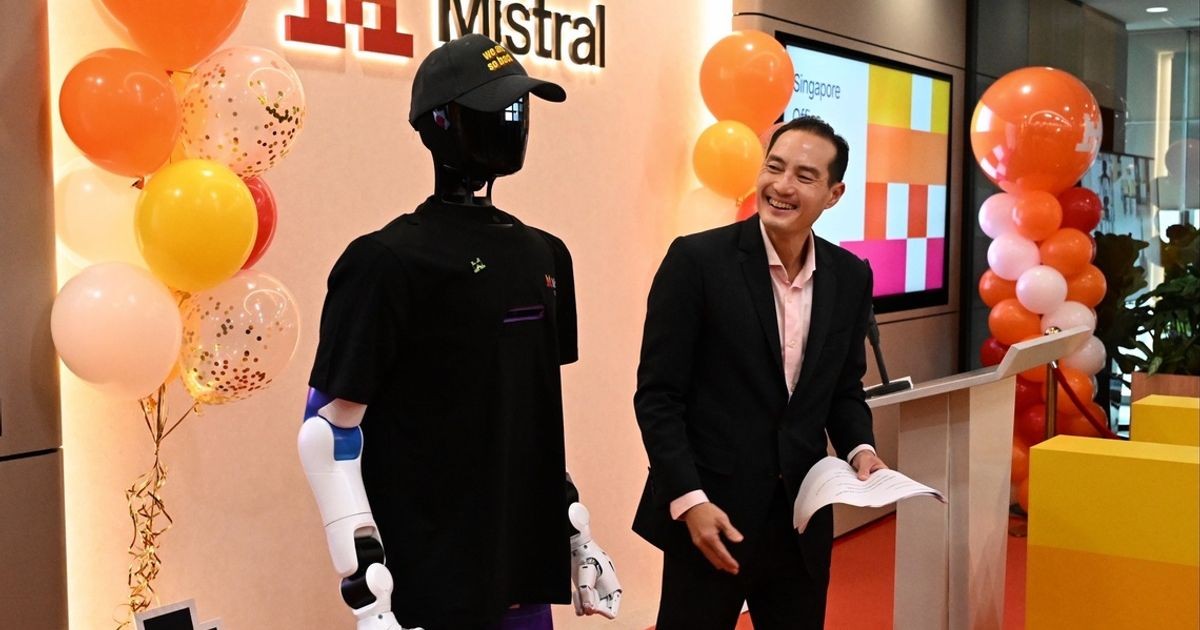
The decision belonged to Arthur Mensch. Mistral’s co-founder and chief executive spent much of this year weighing where the French model maker should put its first substantial office outside Europe, and on Nov 20 the company said the answer is Singapore, with an Asia-Pacific headquarters, an applied AI center for research and industry work, and a regional staff that is meant to reach 200 people by 2027.
The choice is a bet on a specific kind of customer. Mistral sells itself as the sovereign option: a European vendor that will put models inside a customer’s own infrastructure, under that customer’s laws, without routing data through an American cloud. Governments and banks in Southeast Asia have spent two years asking for exactly that, and several have written procurement rules that favor it.
Mensch has made the argument in public for a while. Europe’s answer to the largest American labs, in his telling, is not to build a bigger model but to sell control: weights a customer can hold, deployment that stays inside a border, and contracts that name a jurisdiction. Singapore gives the company a base from which to make the same pitch to buyers who are wary of depending on either Washington or Beijing.
The timing follows the money. Deutsche Telekom took a EUR 100 million stake in Mistral a day before the Singapore announcement, extending a partnership that already put the company’s models into European telecom infrastructure. A funding round led by ASML earlier this year valued Mistral at EUR 11.7 billion. Capital of that size buys time, and time is what a regional expansion consumes.
The comparison with rivals is unflattering on some measures. OpenAI opened an office in Singapore and has been signing enterprise deals across the region. Google and Anthropic have expanded through cloud partnerships rather than owned offices. Chinese open-weight models, free to download and easy to fine-tune, have spread quickly through Southeast Asian developers, which makes price the first question in most conversations there.
Mistral’s answer to price is efficiency and locality. Its models are smaller than the frontier systems from California and can run on modest hardware, which matters to a ministry that cannot buy a thousand accelerators. The company also publishes open weights for part of its line, a posture that appeals to research institutions and irritates some investors who would prefer a purely commercial catalogue.
Executives describe the Singapore center as a place to build applications rather than to train base models, which is the cheaper half of the business and the part closest to revenue. Teams there would adapt models for local languages, for regulated industries and for government workflows, working with customers rather than at a distance from them.
Singapore’s own posture helps. The city-state has published governance frameworks for AI that industry groups helped write, it funds enterprise adoption through existing subsidy schemes, and it has positioned itself as a neutral venue where Chinese and American companies both operate. For a vendor selling jurisdiction and control, that neutrality is the product.
Southeast Asia is an attractive market for the same reasons it is a difficult one. Demand is real: Indonesia, Vietnam, Malaysia and Thailand have all published national AI plans, and Singapore has run a government AI program for years. Budgets are smaller than in the United States, procurement is slow, and each country has its own rules on where data may sit.
The financial cost of the expansion is straightforward. Hiring that many staff in Singapore, where engineering salaries sit near the top of the regional range, is expensive. An office that sells to governments needs local legal, security and compliance staff before it needs researchers, and those roles do not generate revenue in the first year.
There is a strategic cost as well. A company with a few hundred employees that opens a second headquarters spreads its leadership thin. Mistral’s founders have to be in Paris for European regulators and in Brussels for the AI Act debate, and the Asian business will be run by people the founders hired rather than by the founders themselves.
The competitive risk is that sovereign AI turns out to be a procurement slogan rather than a durable market. If governments conclude that a hyperscaler’s regional data center satisfies their residency requirements, the premium for a European vendor shrinks. If they conclude the opposite, and write it into contracts, Mistral’s positioning becomes valuable.
Mensch’s bet is that the second outcome holds, and that Southeast Asia reaches it before the American labs localize enough to make the question moot. The Singapore office will be the test. Its headcount target, its first government contract and its first bank deployment will say more about that bet than any announcement.
The company has given itself until 2027 to staff the office it opened this week.