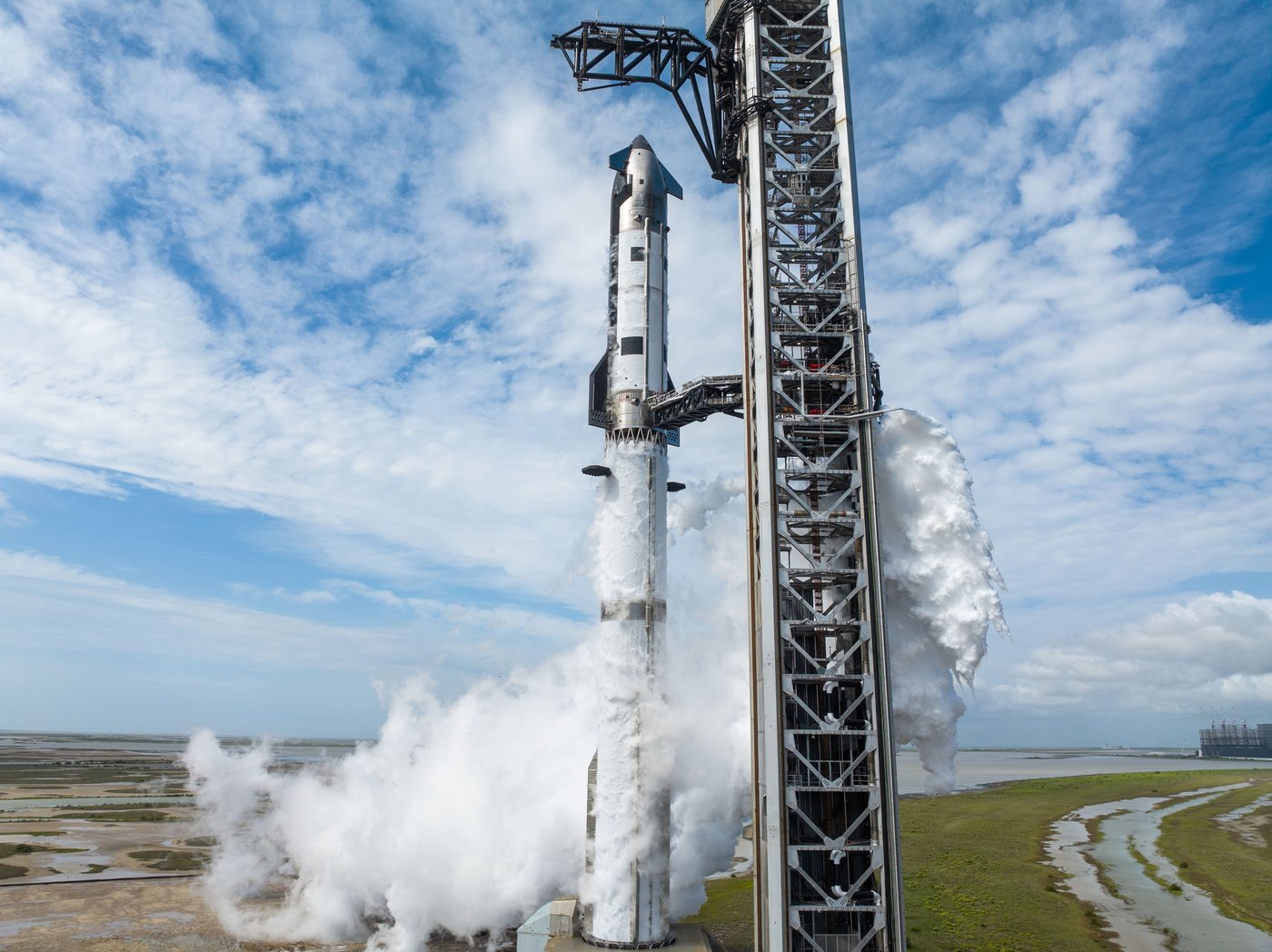
The video SpaceX released Wednesday shows the ship doing something no Starship had done before: settling into the ocean and floating. The clip, shot from a drone above the Indian Ocean west of Australia, captures the 50-meter upper stage tipping over gently after its powered splashdown, flames from residual propellant dying out quickly as the vehicle bobbed on the surface. Previous water landings in the test program had ended in fireballs. This one, on Flight 13 last Friday, came down intact, and the company released the footage as proof.
The flight itself had been mostly routine by Starship standards. The 408-foot rocket lifted off from Starbase, Texas, at 5:51 p.m. Central time on July 24, its 33 methane-fueled Raptor engines steering it east over the Gulf of Mexico before the Super Heavy booster separated and fell back toward the water. The booster’s landing was the one imperfect element: only eight of the 13 engines needed for the landing burn relit, and the stage hit the Gulf at higher speed than planned, a hard splashdown that engineers will dissect. The ship, meanwhile, flew its suborbital arc across half the globe, deployed 20 operational Starlink V3 satellites, survived re-entry and came to rest upright in the water before tipping over.
The splashdown matters for reasons beyond the spectacle. It was the first time the vehicle remained intact after a water landing, which opens the door to towing the ship to shore for detailed inspection, and it clears the way for the next step in the test sequence. Elon Musk, SpaceX’s founder and chief executive, wrote on X after the flight that the company will attempt to catch the ship with the launch tower on the next flight, extending the capture technique SpaceX has already used on Super Heavy boosters to the ship itself. If that works, SpaceX will have both stages of the world’s largest rocket returning to the pad for rapid reuse.
The regulatory clock is moving in the same direction. Barron’s reported this week that the Federal Aviation Administration is considering waiving portions of its launch approval process to accelerate the flight cadence of SpaceX and Blue Origin, the two dominant American launch companies. The agency closed its mishap investigation into the previous Starship flight in May, which allowed Flight 13 to proceed, and a faster licensing path would let SpaceX move from roughly monthly test flights toward the weekly pace its plans require. The FAA’s own statements have emphasized safety, but the direction of travel is clear: the United States wants its space industry launching faster.
The timing is convenient for SpaceX, which has been a public company since June, when its initial public offering raised a record $86 billion on the Nasdaq and placed it among the world’s ten most valuable corporations. Public shareholders have a different tolerance for the fly, fail, fix method than the private investors who funded the first decade of development, and every successful flight is a data point the company can use to justify its capital spending. The Starlink program, which needs hundreds of satellites in orbit this year, gives the cadence question commercial urgency, and the V3 satellite deployment on Flight 13 was a first step toward operational use of the vehicle.
The FAA’s plans would also lift SpaceX’s main domestic competitor. Blue Origin, which has its own heavy-lift rocket in development and a lunar lander contract with NASA, would benefit from the same streamlined approvals, and the agency’s willingness to speed up the industry suggests a broader policy shift toward treating launch capacity as strategic infrastructure. The United States and China are both racing to expand launch rates, and regulators on both sides have been recalibrating how much process is necessary.
The remaining risks are engineering ones. The booster recovery problem, two hard splashdowns in a row, means SpaceX has not yet returned a Version 3 booster to flight, and tower catches of the ship have never been attempted. The next flight, if the ship catch is attempted, will be the most ambitious test in the program’s history, with the vehicle hovering over the pad while mechanical arms close around it. NASA is watching closely: the Artemis program depends on Starship for lunar landings, and the agency needs the vehicle certified for human flight, a bar that no amount of regulatory streamlining can lower.
For now, the industry is reading Flight 13 as the moment the program turned a corner. The ship that finally floated is also the ship that finally behaved like a reusable vehicle, and the FAA’s parallel move on licensing removes the other constraint on the launch rate. SpaceX still has to prove it can catch the ship, refly it and do it at a weekly tempo. The video released Wednesday suggests the company believes it is closer to that than it has ever been.