Dvir Zagury-Grynbaum has a surprise for his partner, and he cannot get through it. He promises a flight to Paris. Before the sentence lands, the other voice cuts in: “Oh my god!” He mentions a hotel. She says she cannot believe he actually pulled it off, and repeats it. Then the conversation drifts to pastries, and he reassures her that eating them will be fine.
The grateful voice belongs to a model. Block published that recording on Oct. 23 alongside Dessa, a voice system the company calls a research preview. Block said Dessa was built from scratch on recordings of human conversation, with no text, no transcription step and no pretrained model underneath. Audio goes in. Audio comes out.
That is not how voice assistants are usually assembled. Most are a chain: a recogniser turns speech into words, a language model writes a reply, a synthesiser reads the reply back. Every link costs a fraction of a second. Every link also discards what the words were wrapped in, the half-second pause before an answer, the flat delivery that tells a listener a joke is not a joke.
Block argues the wrapper is where meaning lives. Ragavan Thurairatnam leads the small lab behind the model, a team founded by former members of the Toronto deep-learning startup that carried the same name and that reports directly to Jack Dorsey, Block’s co-founder. The group started with a narrow question: could a system learn to hold a conversation by listening to people, the way a child learns to speak months before it learns to read? Conversations, on that account, arrive with a plan already attached to how they sound.
The demo recordings show what that looks like in practice. Dessa interrupts. It laughs at the right moment. It answers a request to speak louder by speaking louder, and it keeps talking while it listens, a property engineers call full duplex. In the anniversary clip it also loses the thread, wandering from a T.J. Maxx jumper to whether it will eat a pastry that afternoon, which Block presents as an artefact of a model deciding its own words rather than following a script. Block said the conversations were not steered and that the subtitles were added afterwards.
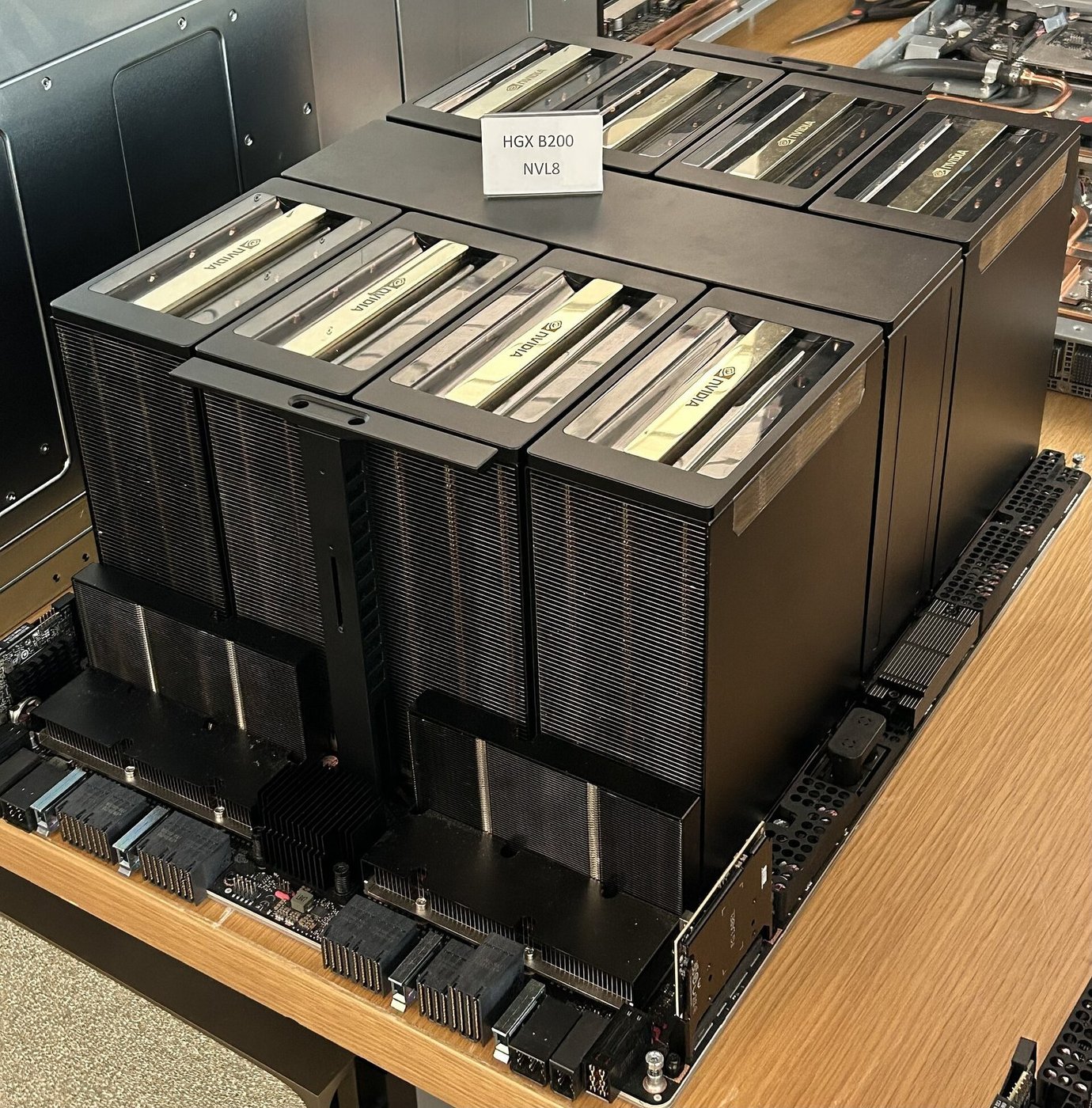
The engineering claims are specific. Block said training ran on a single Nvidia GB200 NVL72 rack, a cabinet that holds 72 Blackwell-generation GPUs and costs several million dollars, and that inference runs locally on a MacBook Pro with an M4 Max chip or better. If that holds outside a curated demo, it puts a real-time conversational model on a laptop instead of behind an API.
What Block has not published matters as much as what it has. There is no evaluation, no benchmark score and no word on how much audio went into training or whose conversations it was. Recordings were chosen by the company. Access is by invitation, with outside safety researchers first in line. The claim that a speech-only model acquired language and facts through sound alone is, for now, a claim.
The arithmetic of that claim is the interesting part. Text models have been fed trillions of tokens skimmed from the web, a corpus assembled almost for free. Spoken conversation does not exist in that quantity. It has to be recorded, cleaned and labelled by turn, and the recording carries voices that belong to identifiable people who mostly did not agree to train a machine. Any company building this way either licenses its audio or collects it, and Block has said nothing about which.
The competitive picture explains the timing. OpenAI, Google and a cluster of startups have all shipped speech systems that listen and answer in one pass, and latency has become the number they compete on. Nvidia’s PersonaPlex, a seven-billion-parameter speech model, has been ported to run on a MacBook in about five gigabytes of memory, which moved the argument from data centres to laptops. Thinking Machines has said the 200-millisecond turn is an architecture problem, not a tuning problem.
Block is an odd entrant. The company, formerly Square, makes money from payments, Cash App and merchant hardware, and from bitcoin. It runs a mining-chip business and owns Tidal. Dorsey has spent years funding research arms that sit outside the payments business, and Dessa is the most consumer-facing thing to come out of one.
The product question is open. A voice that interrupts feels human, and a voice that interrupts wrongly feels worse than one that waits. The recordings Block chose lean hard on charm, and charm is the easiest thing to fake for two minutes. The harder tests are a caller in distress, a noisy room, an accent outside the training set.
For now Dessa is a demonstration that a different starting point is possible: learn from talk, not text. Whether that path scales past a handful of curated conversations is the question the waitlist is standing in for.