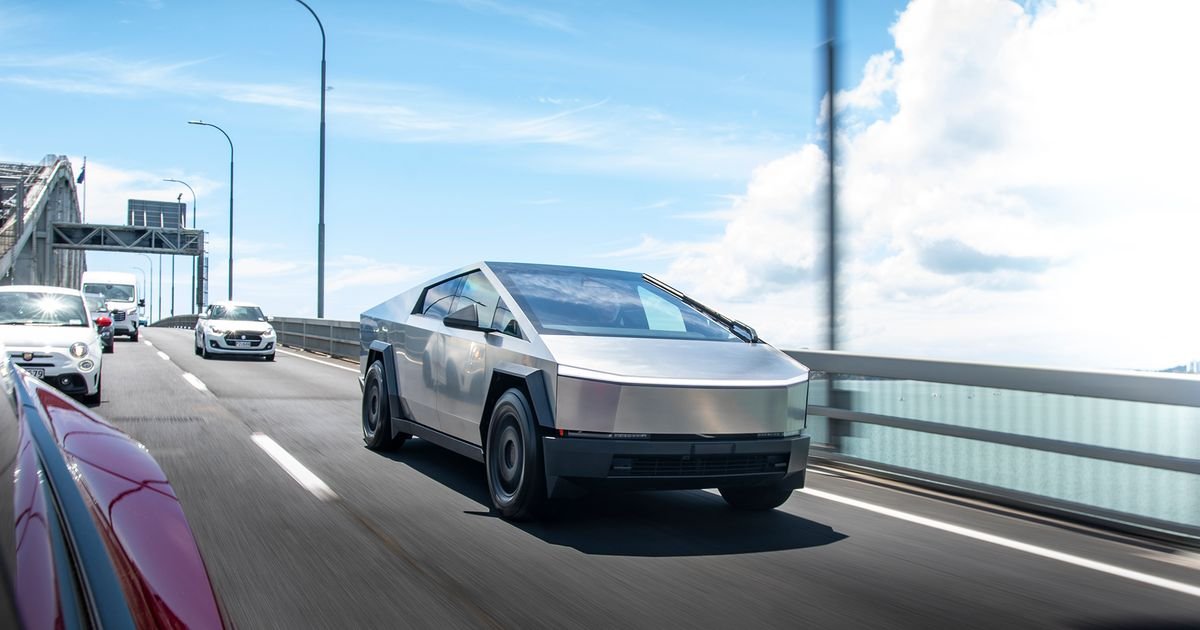
The email that landed in Australian inboxes on October 23 was four sentences long and had been nearly seven years in the making. “After careful consideration, plans to produce Cybertruck for Australia and New Zealand have been discontinued,” it read. “As a result, we’re unable to fulfil your reservation and it will be cancelled.”
The deposit was A$150, taken from November 2019 onward, when the truck was still a wedge of stainless steel on a stage in Hawthorne and the reservation counter on Tesla’s website was climbing toward a million. New Zealand buyers paid NZ$200. Both sums are being returned within 30 days.
For Tesla, the cancellation closes a small but awkward chapter. Australia was not a trivial market on paper. A crowdsourced reservation survey in 2020 ranked it third behind the United States and Canada, at roughly 3% of global reservations, and total reservations across all markets reached an estimated two million by 2023. The company quietly closed the Australian reservation page in May 2022, replacing it with a button offering updates, and did not return deposits then. In 2024 it shipped a Cybertruck to Australia for a display tour, and Elon Musk told shareholders that year that Tesla “might be able to certify it for other markets sometime next year.”
No right-hand-drive version ever appeared. The truck is built in left-hand-drive form only, and Australia, New Zealand, Britain, and Japan all require the steering wheel on the other side. Australia adds its own design rules on top. Tesla’s handful of international launches, in South Korea late last year followed by the United Arab Emirates and then configurators in Saudi Arabia, Qatar, Jordan, and Israel, have all been in left-hand-drive markets. In Europe the truck remains barred, largely over pedestrian-protection standards that a flat stainless nose does not meet.
The volumes never justified the engineering. Tesla delivered 8,295 vehicles in its “Other Models” category in the third quarter, a bucket now almost entirely Cybertruck after the company ended Model S and Model X production. Converting a low-volume, single-market truck to right-hand drive would have meant new tooling, a second crash and certification program, and a separate parts supply chain, for a product selling in the low thousands a quarter worldwide.
Tesla is trying to salvage something from the deposits. Reservation holders who order a Model 3 or Model Y get a year of Full Self-Driving (Supervised), a subscription the company prices at about A$1,788. The offer is a straight conversion play: the two models are built in right-hand drive, they are already in stock in Australia, and the software costs Tesla almost nothing to give away because the marginal cost of enabling it on an existing car is close to zero.
The discounting that followed suggests the inventory problem is larger than one cancelled truck. Tesla began offering up to A$4,050 off Model 3 and Model Y vehicles already in local stock, with orders placed and deliveries taken by December 31. That is a quarter-end, calendar-year, and financial-year push stacked on top of each other, and it is the kind of incentive a company uses when the order book is thinner than the production plan. The shares fell about 2% after the news.
The second thread of Tesla’s week points in the opposite direction. On October 26, the rental marketplace Turo said it had built a direct integration with Tesla’s vehicle API and would begin flagging which Model 3 and Model Y cars on its platform have FSD (Supervised) enabled, starting October 28. Hosts who opt in receive a month of the software free. Renters see a safety briefing and a short instructional video before they collect the keys.
The arrangement solves a problem Tesla has struggled with for years. Its driver-assistance software is expensive to try and hard to sell in a fifteen-minute test drive, because the interesting part of the experience is not a single maneuver but a long, boring drive in which nothing happens. A rental is the cheapest way to put a driver in the seat for three days. It also puts the technology in front of people who do not own a Tesla, which is a different audience from the one that already bought one.
Turo gets a premium listing tier out of it. Tesla gets fleet exposure and, more importantly, a stream of real-world miles in the United States from drivers who did not pay for the software and therefore have no incentive to defend it in a survey.
The risk sits with the naming. “Full Self-Driving (Supervised)” promises a capability the system does not have, and regulators in the United States have spent years examining how Tesla markets it. Putting it into rental cars, driven by people unfamiliar with its limits, on roads they do not know, concentrates exactly the scenario that safety investigators worry about. The pre-rental video is an acknowledgment of that exposure.
Both stories are about the same constraint. Tesla can build a factory faster than it can certify a product for a new market, and it can ship software faster than it can teach a customer to trust it. The Cybertruck refund is what happens when the first limit binds. The Turo listing is what happens when the company decides the second one is worth paying to overcome.