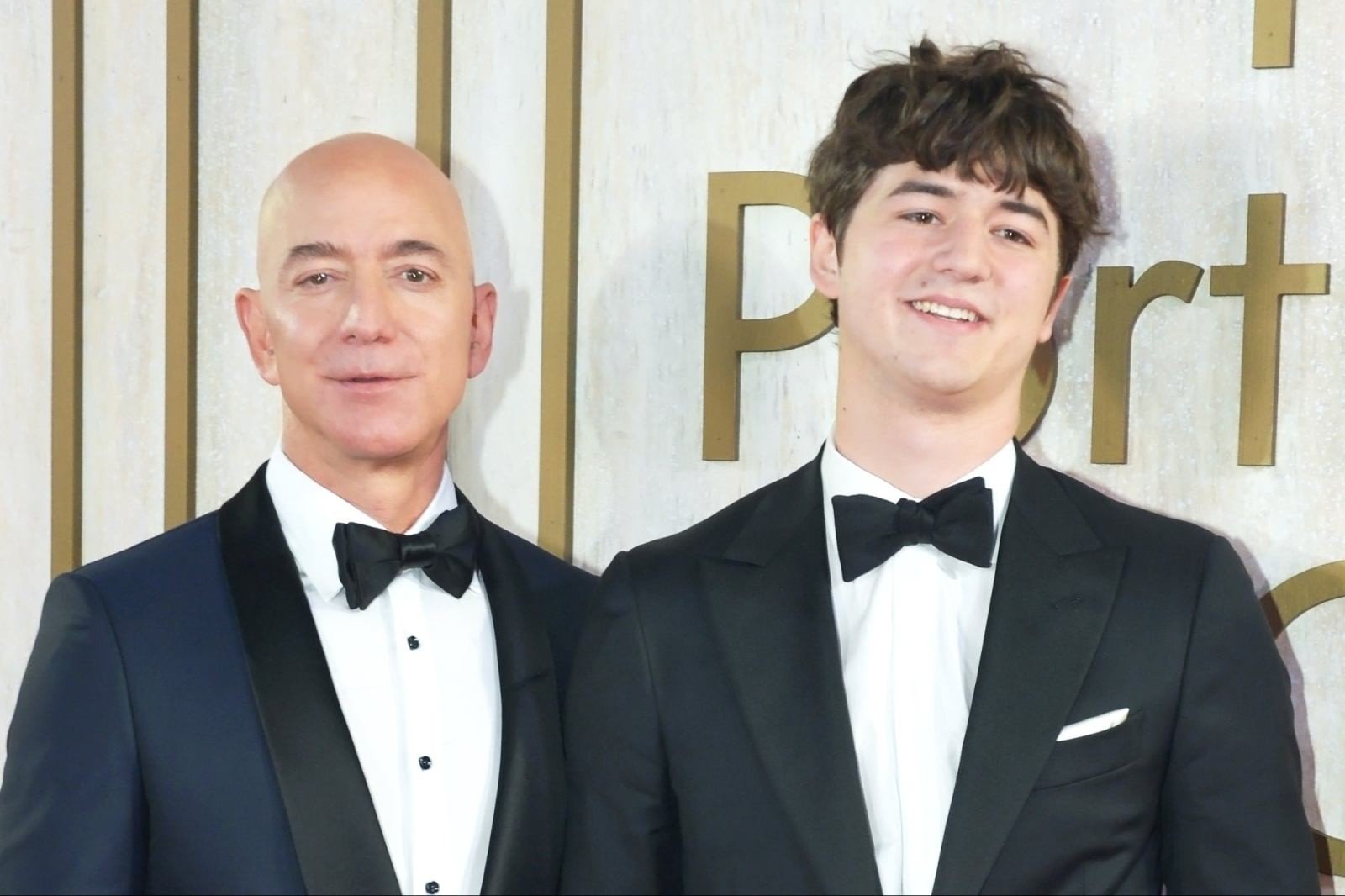
The number is what made the story travel. Five hundred thousand dollars a month, six million a year, paid by a father whose fortune is measured in the hundreds of billions. According to his son, the payments have stopped.
Preston Bezos said in public remarks that his father, Jeff Bezos, cut off his financial support after remarrying, and that the change included the monthly allowance. His account is that the decision followed a conversation inside the household rather than any dispute with him.
The explanation he gave is unusually specific. He said his father’s wife told Bezos there was no reason to keep funding an adult son, on the grounds that MacKenzie Scott received about $35 billion when the couple divorced and could therefore cover the expense herself.
That is Preston Bezos’s version of events, offered without documents and without a second voice. Representatives for Jeff Bezos did not respond to requests for comment, and no third party has confirmed the arrangement or its ending. The story currently rests on one person’s account of a private family matter.
The silence on the other side is normal for the family. Bezos has kept his personal finances and his children out of public view for most of his career, and the people around him rarely discuss family arrangements at all. When they do, it is usually in filings rather than interviews.
What is not in dispute is the scale involved. Five hundred thousand dollars a month is $6 million a year, which is roughly the annual cost of a mid-sized private office, a security detail and a household staff. For a parent with Bezos’s balance sheet, it is a rounding error that happens to be somebody’s entire budget.
Allowances at that level are not really spending money. They are a governance mechanism. Families with very large fortunes typically move adult children onto trust distributions, family LLCs or dedicated offices, in part so that the money arrives with structure attached and in part so that it can be turned off.
Seen that way, the reported decision is less dramatic than the headline. Cutting a monthly transfer is a way of saying that a phase has ended. The interesting question is what replaced it, and on that point the public account offers nothing.
MacKenzie Scott’s position in the story is awkward. She received roughly 4% of Amazon in the 2019 settlement, a stake worth tens of billions at the time, and has since given away a large share of her wealth through unrestricted grants. Using her settlement as the reason a father should stop paying his son’s allowance is a logic that reads more like household negotiation than financial planning.
Bezos’s own philanthropy has followed a different pattern. He has funded a network of preschools, committed money to climate programs and handed out large unrestricted prizes to individuals. None of it is designed as an income stream for his children, and none of it has been presented that way.
Adult children of the very rich occupy an odd position in public life. They are private citizens with public names, and any statement they make about their parents becomes a story about money they did not earn. That asymmetry is why most of them say nothing, and why the ones who do tend to be believed and doubted in equal measure.
There is also an audience question. A $500,000 monthly allowance is a detail that lands differently depending on the reader’s own month. The story spread because the figure is absurd to almost everyone and because it lets people compare a family argument to their own, which is the engine behind most coverage of wealthy households.
From a legal standpoint, none of this is remarkable. Parents in most jurisdictions have no obligation to support adult children, whatever their means, and a change in marital status is a common moment for families to revisit how money moves between generations. What changes is not the law but the expectations inside a family.
The reputational effects are harder to read. Bezos has never traded on a family-man image, and his public persona sits closer to rockets and newspapers than to parenting. A story about a stopped allowance is unlikely to move his standing with investors, creditors or regulators, none of whom care how his son pays for anything.
The people who will care are the ones who know the family. Relatives, family-office staff and the small circle that manages the private side of a public fortune have a clearer view than any reader, and none of them has spoken. In the absence of that, the account stands as a claim rather than a fact.
Preston Bezos appears to have made the remarks without an apparent commercial motive, which is one reason the story has been treated as plausible. He is not promoting a book or a venture in the versions circulating, and he has not followed up with documents or a second interview.
What the episode does illustrate is how thin the information is around the largest fortunes. The public knows the share prices, the filings and the philanthropy, and almost nothing about the internal arrangements that determine how money actually reaches the next generation. A single remark fills a gap that disclosure never covers.
If the arrangement was formal, trusts and entities will eventually show up in filings, and the record will speak for itself. If it was informal, a monthly transfer between a father and a son, then nothing further will surface and the story will stay where it started, in one man’s account of a conversation.
Either way, the arithmetic is what people will remember. Six million dollars a year, stopped, at a moment when the family’s public business is rockets, satellites and a newspaper. The allowance is small next to the fortune. It is large enough to be a story.