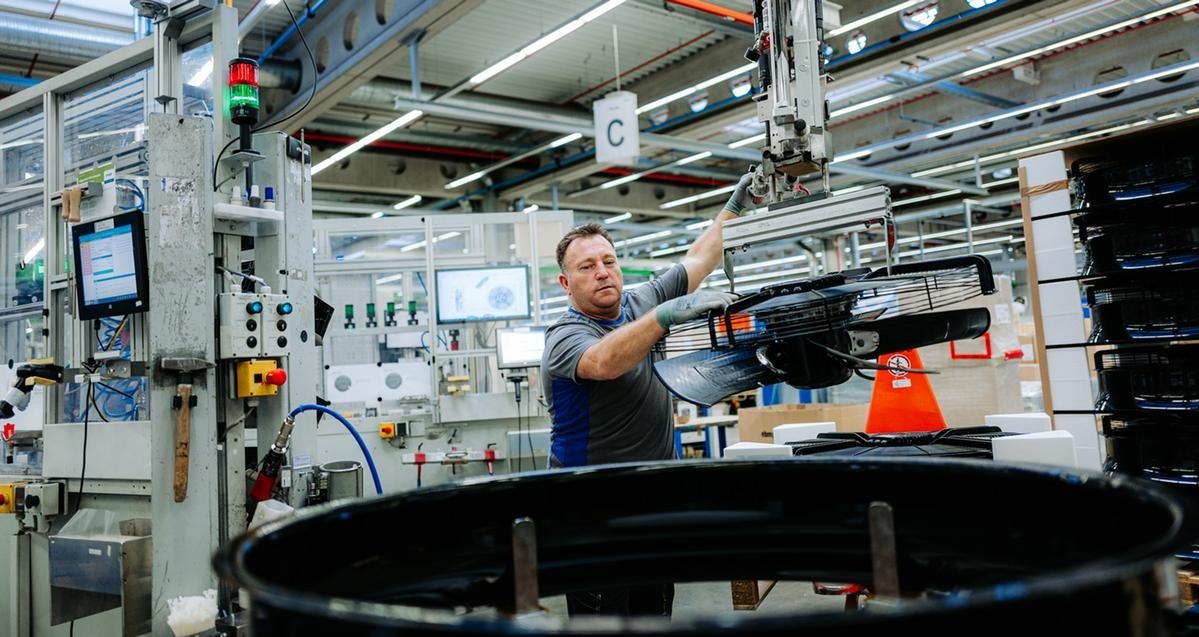
EBM-Papst makes fans. The company’s motors move air through hospital ventilation systems, supermarket refrigeration cases and data-center racks, and it has done so from the small Baden-Wurttemberg town of Mulfingen for the better part of a century, mostly under family control.
This year it changed hands. Madison Air agreed to buy the company for $5.4 billion, one of the largest deals ever struck for a German industrial supplier. The buyer was American.
That transaction is part of a pattern that German business paper Handelsblatt asked PitchBook to measure, and the numbers are stark. In 2025, U.S. capital was involved in 76 acquisitions of, or investments in, German industrial and manufacturing companies. That is the highest count since PitchBook began tracking the category in 2022, and the combined value of about $29.5 billion is close to double the 2022 total.
The pace has not slowed this year. Through Aug. 19, 47 deals worth $23.9 billion had been registered. Of the 7,861 German companies in the data set, U.S. capital holds majority stakes in 1,750, more than any other foreign source.
The second large example is Bain Capital’s takeover of a majority stake in Everllence, the former large-engine unit of Volkswagen. Volkswagen expects to receive about 7.4 billion euros from the transaction.
What the buyers are acquiring is the part of German industry that rarely appears in headlines. These are companies with a few thousand employees, a dominant share of a narrow market, and engineering that customers cannot easily replicate. Many are family-owned, and many are running into the same wall: the owners are in their sixties or seventies, their children have chosen other careers, and there is no obvious internal successor.
Selling to a financial sponsor solves that problem in one step. It converts an illiquid family asset into cash, keeps the factory running, and leaves management in place. For the seller, the alternative is often a sale to a Chinese strategic buyer, which raises political complications in Berlin, or a merger with a domestic rival that may not exist.
The valuation gap does the rest. German industrials trade at discounts to American peers, and the discount widened after 2022, when energy costs jumped and the export model that supported the Mittelstand came under strain. A buyer with dollar-denominated capital and access to cheap debt can pay a price that looks generous in Stuttgart and cheap in New York.
The pressure on the sellers is real. Chinese competitors have closed the quality gap in machine tools, automotive components and electrical equipment, and they compete on price in exactly the export markets where German mid-sized firms earn their margins. Energy costs remain well above pre-2022 levels. The automotive supply chain, which accounts for a large share of these companies, is being rebuilt around electric drivetrains that need fewer parts.
Private-equity ownership brings its own questions. Sponsors typically hold for five to seven years, load the company with debt, and sell again. Critics in German labor unions argue that the model extracts value from engineering capabilities that took decades to build. Defenders point out that the alternative, for many of these firms, is slow decline under an owner with no plan.
Works councils have become a factor in deal negotiations. German co-determination rules give employees seats on supervisory boards at larger companies, and a change of control triggers consultation. Several of the 2025 transactions ran into organized opposition, and at least one required commitments on investment and employment to close.
Chinese buyers used to be the obvious alternative, and for a stretch in the 2010s they were the most active foreign acquirers of German machinery companies. That channel narrowed as Berlin tightened screening and as Beijing’s own capital controls made large outbound deals harder to finance. The American bidder that remains is easier to clear politically, even when it is a financial sponsor with a short holding period.
The American operating model is familiar by now. Buy a platform, bolt on smaller competitors in the same niche, move the combined company to a single ERP system, and sell the result to a larger industrial group or another sponsor. For a company that has been run by one family for three generations, the first two years of that process can be jarring, particularly when the new owner closes a site that the founding family kept open out of loyalty.
Berlin has noticed. Germany tightened its foreign investment screening regime in recent years, and the economics ministry can review acquisitions in sectors deemed sensitive, including some industrial machinery and energy equipment. American buyers generally clear that review without difficulty, which is part of why the flow has continued.
For the German economy, the consequence is a slow transfer of ownership in the segment that generates most of its exports. The companies keep their names, their plants and usually their managers. What changes is where the profits go, and who decides whether a factory in Baden-Wurttemberg gets the next round of capital or a plant in Mexico does.
Bankers involved in the deals expect the pipeline to hold. The succession problem is not going away, the valuation gap is still wide, and American sponsors have capital committed to European industrials that they need to deploy. The next EBM-Papst is likely already in a data room.